
East Boreham Business & Resident Action Group
Help Us Stop the Home Farm Development
Bellway’s speculative planning proposal would have a detrimental impact on the rural setting and tranquillity of the surrounding area, qualities that contribute significantly to the local visitor economy. Nearby businesses, including Bishopstrow Hotel, rely upon the preservation of the area’s attractive and largely unspoilt landscape to attract visitors and support local employment. The permanent urbanisation of these historic surroundings risks undermining local tourism and economic sustainability. This is contrary to paragraph 89 of the NPPF, which seeks to support a prosperous rural economy whilst recognising the importance of protecting environmental and heritage assets that contribute to the attractiveness of rural areas.
The proposal would cause unacceptable harm to biodiversity, heritage assets, landscape character and settlement identity. The site is an unsuitable location for development at the scale proposed. For these reasons, Wiltshire Council should refuse planning permission for Application PL/2026/02717.
The Wylye Valley corridor between Stonehenge and Warminster contains one of the most archaeologically significant landscapes in southern England. The area includes Neolithic long barrows, Bronze Age barrow cemeteries and Iron Age hillforts, including Battlesbury Camp and Scratchbury Camp. Archaeological investigations near the proposed Home Farm allocation have already identified evidence of multi-period settlement activity. Under NPPF paragraphs 189–202, planning policies should ensure that the significance of heritage assets is properly understood and that harm is avoided where possible. Allocation of development before comprehensive archaeological assessment has been completed risks irreversible loss of heritage evidence.
Warminster has experienced significant flooding events in recent years, including major incidents in 2014 and 2024, affecting homes, businesses and infrastructure. Development on land that functions as natural drainage pathways does not remove flood risk; it can increase runoff and displace flooding elsewhere, particularly within complex catchments such as the upper River Wylye system. Under NPPF paragraph 160, planning policies should apply a sequential risk-based approach to development, while paragraph 167 requires development to ensure flood risk is not increased elsewhere and that cumulative impacts are properly assessed. Strategic planning evidence has previously recognised that Warminster’s hydrology is complex, and that a Level 2 Strategic Flood Risk Assessment (SFRA) is required to properly assess flood risk associated with site allocations. Because of this complexity, site-specific flood risk assessments prepared at planning application stage cannot substitute for a town-wide Level 2 SFRA, which is required to understand cumulative and off-site impacts across the catchment. A Level 2 SFRA has not been prepared for Warminster and without this strategic assessment, it is unclear: how cumulative flood impacts have been assessed, whether development could increase flood risk elsewhere and whether the allocation complies with national flood risk policy. For these reasons, Wiltshire Council should refuse planning permission for Application PL/2026/02717.
The proposed access arrangements for development at Home Farm raise concerns regarding highway safety. Boreham Road already experiences a mix of traffic including buses, heavy goods vehicles and military traffic, and contains constrained sections and bends. Under NPPF paragraphs 105 and 110, development should ensure safe and suitable access for all users and minimise reliance on private vehicles. Standing traffic entering the Home Farm development just after the blind bend into Warminster is likely to be a safety risk. Until clear evidence demonstrates that safe access can be achieved without unacceptable impacts, this speculative planning should be rejected.
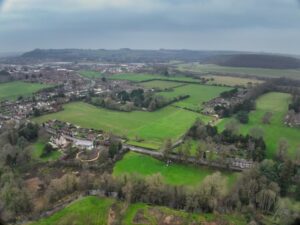
The proposed development is outside the Warminster settlement boundary, situated on the urban/ rural fringe of the town. Should planning permission be granted, it would effectively close the existing green gap between the town and the surrounding countryside and landscape. The site is also very close to the Bishopstrow Conservation area which borders the proposed site on two sides. Is there not a need to safeguard and protect this area of countryside? This plot of land has not been allocated in any local or county development plans and there was resounding opposition to its naming as a potential site for development in the Draft Neighbourhood Plan as such, PL/2026/02717 should be refused.
Bellway make much in their application of their attempts to preserve existing heritage and conservation assets but in reality, the proposed access point largely ignores previous documented archeological and conservation concerns around a development with an access point off the Boreham Road, in favour of following the recommendations/opinions of consultants in their employ. Failure to acknowledge historical comment and opinion on these issues is a failure to acknowledge and understand the complexities of this site. For this reason alone, Wiltshire Council should refuse planning permission for Application PL/2026/02717.